JAYPRAKASH S Chauhan
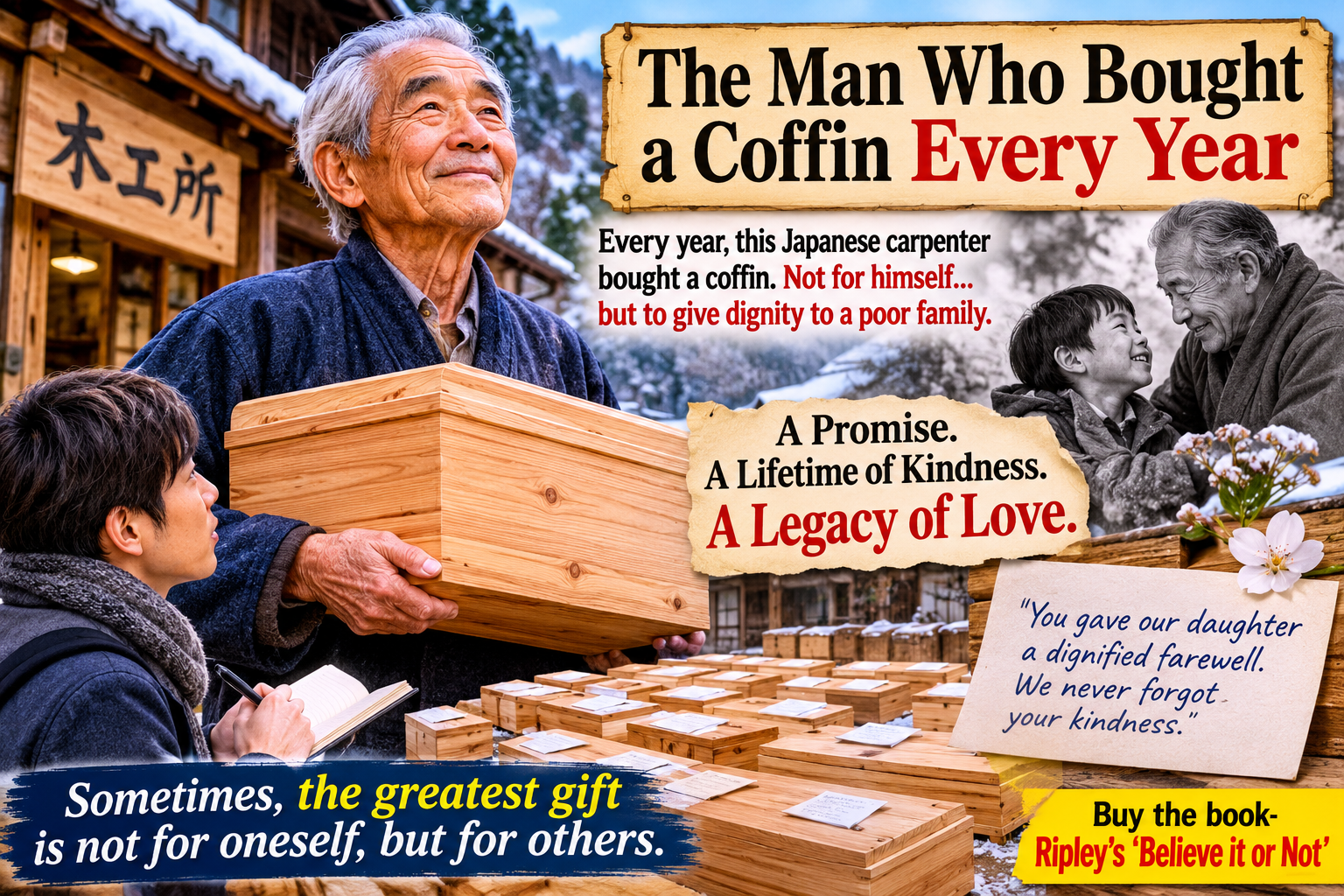
In a small village in Japan, there lived an old carpenter named Hiroshi. He was a quiet man who owned a tiny furniture shop near the village market. He was the man who bought a coffin every year.
Every year, on the same day, he visited the local coffin maker and purchased one coffin.
People found this strange.
Why would a healthy old man buy a coffin every year?
Some villagers thought the carpenter was preparing for his own death. Others believed he was superstitious. A few even joked that he must be the coffin maker’s most loyal customer.
But Hiroshi never explained himself.
One winter morning, a young journalist named Kenji arrived in the village. He was writing a newspaper article about unusual people and their habits.
When he heard about Hiroshi, he became curious.
He visited the carpenter’s shop and asked, “Sir, may I ask you something? Why do you buy a coffin every year?”
Hiroshi smiled gently.
“Because I have made a promise,” he replied.
“A promise to whom?”
Hiroshi looked out of the window. Snow was falling slowly.
“Twenty-five years ago, I had a son. His name was Akira. He was only twelve years old when he died in an accident.”
Kenji lowered his notebook.
Hiroshi continued.
“After my son’s death, I noticed something heartbreaking. Poor families in our village could not afford proper funerals. Some children were buried in makeshift wooden boxes. Their parents were already suffering, and they could not even give their children a dignified farewell.”
He paused and continued
“That year, I made my first coffin. I gave it to a poor family whose little daughter had died. I did not take any money.”
Kenji listened carefully.
“Since then, every year on my son’s birthday, I buy a coffin and donate it to a family that cannot afford one.”
The journalist was speechless.
“But why don’t you simply donate money?” he asked.
Hiroshi, the carpenter, replied, “Money can be spent on many things. But sometimes, a family needs something very specific at the most painful moment of its life.”
Kenji finally understood.
He published Hiroshi’s story in the newspaper. Within a few days, donations began arriving from different parts of Japan.
Some people sent money. Others sent wood. A furniture company offered to supply materials free of cost.
Soon, Hiroshi’s small workshop became a charitable centre.
Years passed.
One morning, Hiroshi died peacefully in his sleep.
The villagers gathered to pay their respects. His funeral was simple, but something unusual happened.
Outside his workshop stood twenty-five empty wooden coffins.
Each coffin carried a small handwritten note.
The villagers opened the notes one by one.
They were messages from families who had received his help over the years.
One message read:
“You gave our daughter a dignified farewell. We never forgot your kindness.”
Another said:
“You helped us when the whole world seemed to have abandoned us.”
The last note was from a young man who had once received one of Hiroshi’s coffins for his little brother.
It read:
“Sir, I was that little boy’s elder brother. You gave my family dignity when we had nothing. Today, I am a carpenter. I will continue your work.”
The villagers looked at one another with tears in their eyes.
They had thought Hiroshi was preparing for death every year.
In reality, he had been preparing to give dignity to someone else’s final journey.
And that was the greatest furniture he had ever made—not a coffin, but a legacy of kindness.
Buy the book- Ripley’s ‘Believe It or Not’ at https://link.amazon/B01b9rxcp