J S Chauhan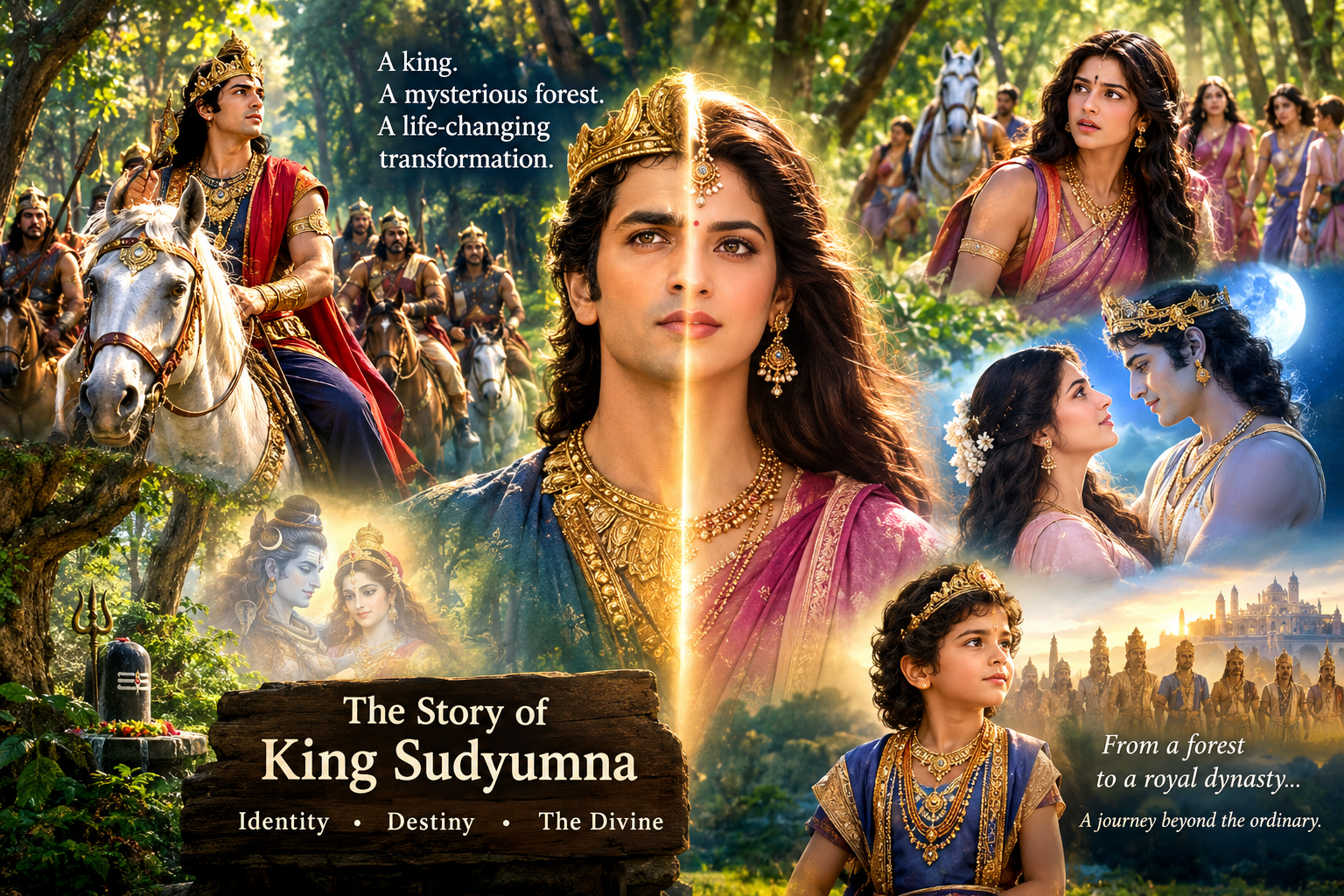
There are some stories from ancient India that are difficult to forget. These are the stories from the Mahabharata, the Ramayana and the Puranas. One such story is that of King Sudyumna. The king who became a woman.
Not because the stories are frightening, or because they describe great wars, but because they ask questions that still puzzle human beings today.
Who are we? Is our identity determined only by our body?
And what happens when a person suddenly becomes someone he never imagined he could be?
One such extraordinary story is the story of King Sudyumna.
It begins in a forest. But this was no ordinary forest. It was a mysterious forest.
The Mysterious Forest
Long ago, there lived a powerful king named Sudyumna. He was a brave ruler and a skilled hunter. One day, accompanied by his soldiers and hunting companions, he went deep into the forest.
The forest was beautiful and frightening.
Tall trees covered the sky, sunlight came through the leaves in golden patches, and the sound of birds echoed among the branches.
Sudyumna and his companions continued riding and went deeper into the forest.
They had no idea that they were approaching a cursed place touched by a strange divine power.
According to the ancient story, the forest had once been visited by Lord Shiva and Goddess Parvati.
There was a special reason why the place had become extraordinary.
A condition had been placed upon the forest:
Any male who entered it would be transformed into a woman. A male turning into female!
It was not an ordinary curse that could simply be avoided.
And King Sudyumna knew nothing about it.
He crossed the boundary of the forest.
Then something unbelievable happened.
His horse changed.
His companions changed.
And King Sudyumna himself was transformed into female.
The king who had entered the forest as a powerful warrior suddenly found himself in the body of a woman.
He was stunned.
His companions were equally shocked.
The entire hunting party had become female.
For a moment, nobody knew what to do.
The proud king who had entered the forest with weapons and horses could hardly believe what had happened.
“What has happened to me?”
There was no answer.
Transformation from Sudyumna to Ila.
Sudyumna was now known as Ila.
The king’s old identity seemed to have disappeared.
Imagine the confusion and chaotic situation.
A person who had lived his entire life as a king, a warrior and a ruler suddenly had to understand an entirely different existence.
Ila could remember everything.
The kingdom.
The palace.
The people.
The hunting expedition.
But the body was no longer the same.
Ila was trapped in a situation that seemed impossible.
Eventually, the matter came to the attention of Lord Shiva.
King Sudyumna’s former life could not be restored permanently?
Yes, divine intervention provided a strange solution.
Sudyumna would be able to live alternately as a man and a woman. That was the solution.
For one period he would be Sudyumna.
For another, Ila, the woman.
Thus began a life unlike that of any ordinary king.
The Meeting with Budha
The story then takes another unexpected U-turn.
During the period when Ila lived as a woman, Ila encountered ‘Budha,’ the son of the Moon. (The actual name of Budha in English is Mercury)
Budha was a wise and powerful divine being.
He was deeply attracted to Ila, and the two eventually came together.
From their union was born a son named Pururavas.
This is where the story becomes even more important in Hindu mythology.
Pururavas became a celebrated and brave king and is traditionally regarded as the ancestor of an important royal lineage.
So, from an extraordinary transformation in a mysterious forest came an important royal dynasty.
But Sudyumna’s strange existence was not yet over.
A King With Two Lives!
King Sudyumna eventually returned to his kingdom.
But he was no longer simply the man who had once gone hunting.
He carried an extraordinary secret.
He had experienced life both as a man and as a woman.
His transformation had changed more than his appearance.
It had changed his understanding of life itself.
He had experienced the world from two completely different positions.
The story therefore becomes more than a tale about a supernatural transformation.
It becomes a story about identity, destiny and the mysterious power of the divine.
Why Did This Happen?
Ancient Puranic stories rarely present such events merely as entertainment. There is some philosophy to understand.
There is usually a deeper idea hidden underneath them.
The story of Sudyumna reminds us that the identity we consider permanent can sometimes be surprisingly fragile.
We spend our lives saying:
“This is who I am.”
But the ancient sages repeatedly asked us to look deeper.
Are we merely the body?
Are we merely our name?
Are we merely our position in society?
Sudyumna was a king.
Then he became Ila.
Yet the person who remembered the past was still there.
The story therefore raises a question that is surprisingly modern:
If everything about our external identity changes, what remains of the person inside?
Imagine what will happen if your personality suddenly changes.
The Strange Wisdom of the Story
Today, we live in a world where identity is often connected with our profession, appearance, wealth, family and social position.
A person may say:
“I am a professor.”
Another may say:
“I am a businessman.”
Someone else may say:
“I am a king.”
But these are descriptions of our circumstances.
Circumstances can change.
Sudyumna’s story takes that idea to an extreme.
He loses the identity he thought was permanent and is forced to experience another life.
Perhaps that is why this ancient story has survived for so long.
It is strange.
It is supernatural.
But beneath the supernatural element lies a very human question.
How much of our identity comes from the world around us, and how much comes from within?
The Legacy of Ila
The story does not end with Sudyumna’s transformation.
Through Ila and Budha came Pururavas, whose descendants became part of the famous lunar dynasty of Indian mythology.
Thus, an apparently bizarre incident in a mysterious forest became connected with generations of kings and heroes.
And that is one of the fascinating characteristics of the Puranas.
A story may begin with something seemingly impossible—a curse, a blessing, a transformation or a divine encounter—and eventually connect with a much larger story of creation, kings, sages and gods.
The story of Sudyumna is therefore not simply the tale of a king who became a woman.
It is the story of a person forced to cross the boundaries he thought could never be crossed.
A king entered a forest.
He emerged as someone else.
And in that strange transformation, he discovered that destiny does not always follow the path that human beings plan for themselves.
Perhaps that is the real mystery of the story.
We think we know who we are.
We think we know where our lives are going.
But sometimes, as the ancient storytellers understood very well, one step into the unknown can change everything.
And sometimes the strangest stories are the ones that make us look at ourselves differently.
We need to transform ourselves to come to know who we are.
The journey into eternal life would begin when we transform ourselves.
This is from the Devi Bhagavata Purana stories