JAYPRAKASH S Chauhan
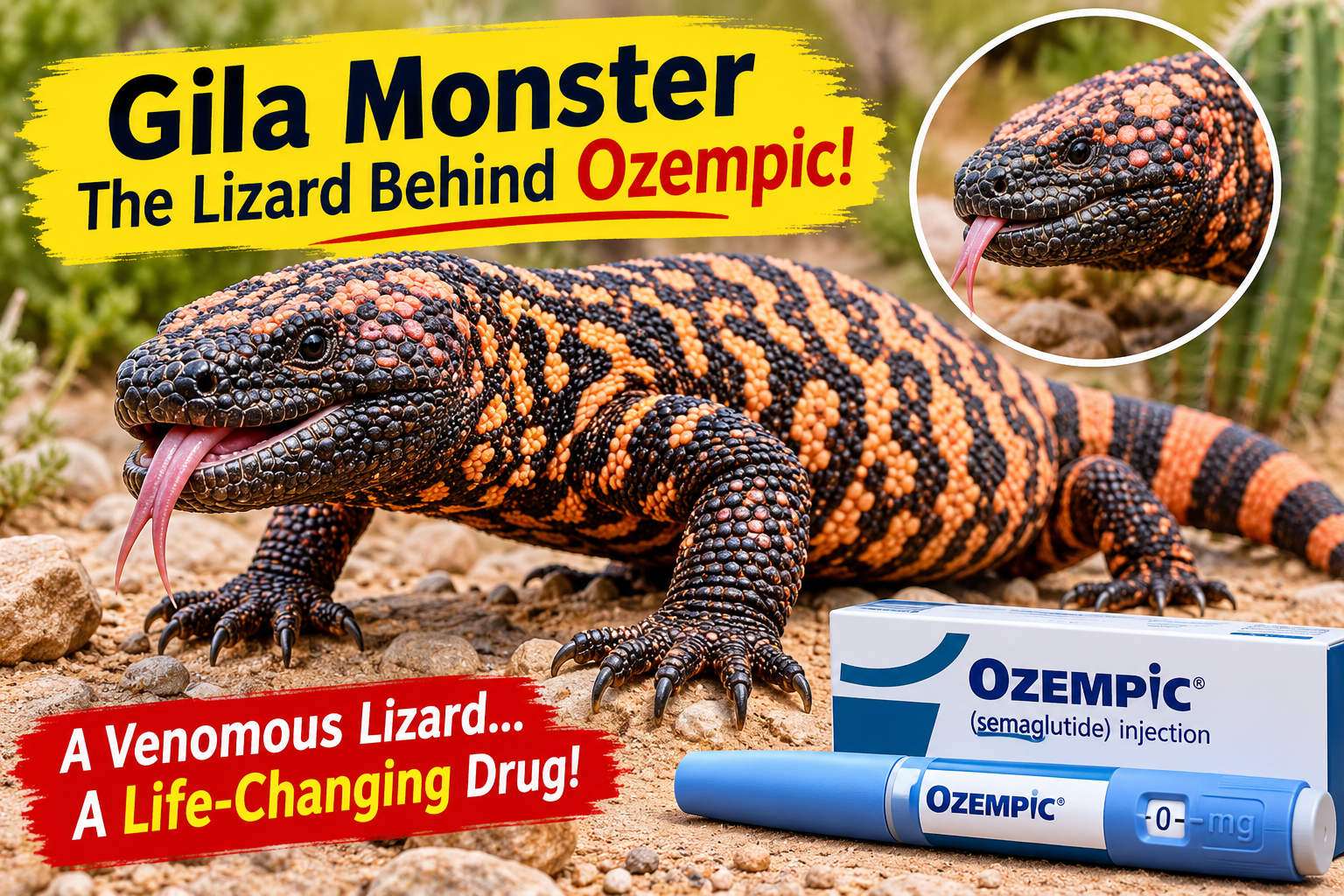
This is an amazing story of the invention of Ozempic. Scientists were inspired by the venomous lizard. It led them towards the development of Ozempic.
Imagine a small lizard living in the deserts of America. It is slow-moving, spends long periods without food and has a rather frightening appearance.
Nobody could have imagined that this creature would one day inspire scientists to develop medicine-Ozempic. Ozempic, which would change the lives of millions of people around the world.
This is the fascinating story behind Ozempic, one of the most talked-about medicines of recent years.
You may have heard that Ozempic was extracted from the venom of a lizard.
There is some truth behind this unusual story, but the actual discovery is even more interesting.
Ozempic itself does not come from lizard venom.
However, research on a venomous lizard helped scientists discover an important substance that eventually opened the door to a new generation of diabetes and weight-loss medicines.
The Mysterious Lizard of the American Desert
The creature is called the Gila monster. It is a venomous lizard found mainly in the southwestern United States and northwestern Mexico.
Unlike many other animals, the Gila monster can survive for long periods without eating. It stores energy in its body and has an unusual ability to manage its metabolism.
Scientists became interested in understanding how this animal could maintain its blood sugar levels despite eating so infrequently.
During research into its venom and saliva, scientists discovered a special substance called Exendin-4.
This discovery would eventually become an important chapter in the history of modern medicine.
A Scientist Makes an Unexpected Discovery
The story takes us to the work of Dr John Eng, a researcher who studied substances found in the venom of the Gila monster.
In 1992, his research identified Exendin-4, a substance that attracted considerable scientific attention.
Scientists discovered that Exendin-4 behaved in a way similar to a natural hormone in the human body called GLP-1 (glucagon-like peptide-1).
What makes this discovery particularly interesting?
The human body naturally produces GLP-1 after eating food. This hormone helps the pancreas release insulin when blood sugar levels rise. Insulin helps move sugar from the blood into the body’s cells, where it can be used for energy.
However, there was a problem. Natural GLP-1 disappears very quickly from the human body. It remains active for only a few minutes.
Exendin-4 was different. It remained active much longer.
Scientists realised that this lizard-derived substance might help people suffering from type 2 diabetes.
It was an extraordinary discovery. A substance found in a venomous desert lizard had provided an important clue for treating a serious human disease.
From Lizard Venom to a Diabetes Medicine
The next challenge was to turn this discovery into a useful medicine.
Scientists developed a synthetic version of Exendin-4 called Exenatide. It was marketed under the brand name Byetta and received approval in the United States in 2005 for treating type 2 diabetes.
The medicine helped patients control their blood sugar levels. Researchers also noticed something interesting: many patients taking it were losing weight.
This observation attracted further scientific interest.
Could a medicine developed for diabetes also help people struggling with obesity?
The answer encouraged pharmaceutical companies to investigate the relationship between blood sugar, appetite and body weight.
The Birth of Ozempic
While Exenatide was an important breakthrough, scientists continued searching for better medicines.
A Danish pharmaceutical company, Novo Nordisk, began developing a new substance based on the natural human GLP-1 hormone.
After years of research, scientists developed Semaglutide.
Unlike Exenatide, which was based on the lizard’s Exendin-4, Semaglutide was designed as a modified version of human GLP-1. It was specially developed to remain active in the body for much longer.
Semaglutide is the drug or ingredient, and Ozempic is one brand name for it.
This was a major improvement. Instead of requiring daily injections, the new medicine could be administered once a week.
In December 2017, the US Food and Drug Administration (FDA) approved Ozempic for adults with type 2 diabetes.
The medicine helped patients control their blood sugar levels. It also reduced appetite and helped many patients lose weight.
The discovery of Ozempic was therefore not a direct extraction of medicine from a lizard. It was the result of decades of scientific research that began with an unexpected discovery in the venom of the Gila monster.
Why Has Ozempic Become So Popular?
Ozempic became particularly famous because of its effect on body weight.
The medicine works by imitating the GLP-1 hormone. It helps the body release insulin when blood sugar rises, slows the movement of food through the stomach and reduces appetite.
As a result, people taking it may feel full for longer periods and eat less food.
This has made semaglutide an important development in the treatment of obesity as well as type 2 diabetes.
However, there is an important distinction. Ozempic is approved for treating type 2 diabetes, while another semaglutide product, Wegovy, is specifically approved in certain countries for chronic weight management.
Ozempic is not a magic solution for losing weight. It can have side effects, including nausea, vomiting, diarrhoea and constipation. It should only be used under proper medical supervision.
Nature Sometimes Holds the Secrets of Medicine
Perhaps the most fascinating part of this story is the role played by nature.
A small, venomous lizard living in the deserts of America contributed to scientific research that eventually helped millions of people.
Nobody originally set out to create a blockbuster weight-loss medicine from a lizard. Scientists were simply trying to understand how different living creatures control their metabolism.
Their curiosity led to an unexpected discovery. That discovery inspired further research, and further research produced medicines that have changed modern diabetes treatment.
The story of Ozempic reminds us that some of the greatest scientific discoveries begin with simple questions.
Why can this animal survive without food for so long? How does its body manage blood sugar? Can nature teach us something that modern medicine has not yet discovered?
Sometimes, the answer is hidden in the most unexpected places.
The next time somebody talks about Ozempic, remember the little desert lizard called the Gila monster. It did not give the world Ozempic directly, but it helped scientists find an important clue that changed the future of medicine. Read more at
To sum up, Exendin-4 inspired an early diabetes drug, Exenatide, while Ozempic contains semaglutide, a separately developed GLP-1 medicine.
You may buy the products at https://link.amazon/B078MgK1K